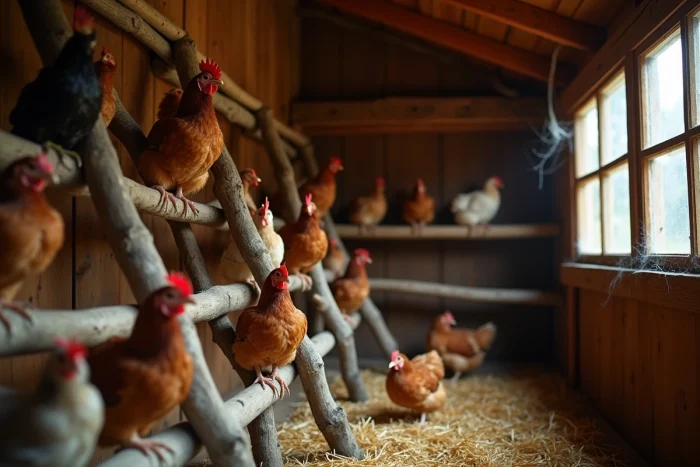
A poorly designed ladder in a chicken coop is useless. Worse, it can become an obstacle that chickens systematically avoid. Installing a ladder or access ramp is not just about placing boards between the ground and the perch: the angle, spacing of the rungs, and support surface directly affect how your poultry will use it.
Slope and support surface: the technical parameters that change everything
A ramp that is too steep will be ignored by the majority of the flock. Recommendations from the University of Minnesota Extension emphasize a moderate slope, less than 45 degrees, with regularly spaced rungs to provide stable support points.
The surface must be non-slip. Unfinished raw wood, crosspieces nailed every ten to fifteen centimeters, or even a gritty coating are sufficient. Smooth or wet wood turns the ramp into a slide, causing slips and micro-traumas to the legs.
We regularly observe that some breeders install round-rung ladders, inspired by perches. This choice is suitable for nighttime resting, not for climbing. To ascend, a chicken needs a flat surface under its foot, not a cylindrical rung that excessively strains the flexor tendons. If you are looking to better understand the benefits of a ladder for a chicken coop, the distinction between access ramp and resting perch is the first point to master.
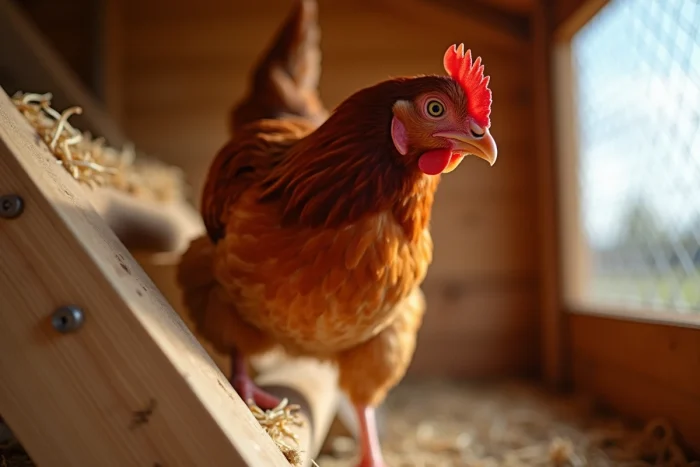
Ladder for heavy, old, or injured chickens: a mobility aid
Light breeds (Leghorn, Padoue) can easily fly up to a perch located one meter off the ground. For them, the ladder is optional comfort. The situation changes radically with heavy breeds: Orpington, Brahma, Sussex. A heavy chicken jumping from a high perch without a ramp risks injuries to the keel and joints, especially on hard ground.
The RSPCA Australia and the Merck Veterinary Manual emphasize that the locomotion of older or recovering chickens deteriorates rapidly without gradual access. A fracture of the keel, common in laying hens at the end of their cycle, often goes unnoticed. The ramp reduces the height of the jump and limits these silent traumas.
- Heavy breed chickens (Brahma, Orpington, Faverolles): a ramp is almost mandatory as soon as the perch exceeds the height of the animal’s back.
- Older or recovering chickens: a temporary ramp allows access to the perch without forcing the chicken to sleep on the ground, where it is exposed to parasites.
- Chicks and young birds: a low-slope ladder facilitates learning to perch, especially in elevated coops on stilts.
Drainage under elevated chicken coop: the ladder does not eliminate the need to maintain the ground
Many articles present the elevated chicken coop as a moisture-proof solution. We recommend qualifying this statement. Without drainage or maintenance of the ground under the structure, the space becomes a breeding ground for parasites.
Rainwater flows from the roof, accumulates under the floor, and the shaded area dries slowly. The result: a muddy ground that attracts red mites and intestinal worms. The ladder or access ramp, if it rests directly in this mud, deteriorates and loses its grip.
Penn State Extension recommends laying a draining gravel bed under elevated chicken coops and regularly checking that the base of the ramp does not stagnate in water. A simple elevation of the ladder base by a few centimeters, placed on a slab or concrete block, is enough to extend its lifespan.
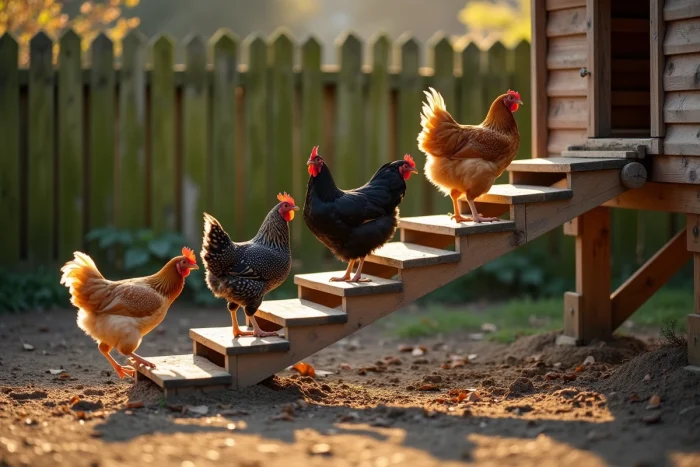
Designing a chicken coop ladder: materials and sizing
Wood remains the reference material. Aluminum, sometimes used for its lightness, poses a thermal conduction problem: cold in winter, burning in summer under direct exposure. Chickens’ feet, which lack feathers, are sensitive to this.
The sizing depends on the number of birds. A ramp that is too narrow creates bottlenecks at the entrance of the coop, causing stress and pecking. We recommend a minimum width that allows two chickens to pass each other without conflict.
- Width: sufficient for two chickens to pass simultaneously, approximately the width of the coop door.
- Crosspieces: made of raw wood, fixed perpendicularly, spaced regularly to accommodate the chicken’s natural step.
- Fixation: the ramp must be stable, with no lateral play. A ladder that moves under the weight of the animal will be abandoned within a few days.
- Maintenance: regular cleaning of droppings accumulated on the crosspieces maintains grip and limits bacterial proliferation.
Adapting the ladder to the terrain configuration
A coop placed on sloping ground requires a longer ramp on the downhill side to compensate for the elevation. Conversely, on the uphill side, the ramp can be short or even unnecessary if the ground is nearly level with the opening.
In an environment where terrestrial predators (foxes, weasels) are present, some breeders remove the ramp at night after the chickens are inside. This simple action adds an extra barrier, provided the hatch is also closed.
The ladder in a chicken coop is not a decorative accessory. It is a functional device that affects the locomotor health of the flock, the sanitary management of the space under the floor, and the fluidity of daily movements. The difference between a used ramp and an ignored ramp lies in a few design details that the chickens perceive immediately.