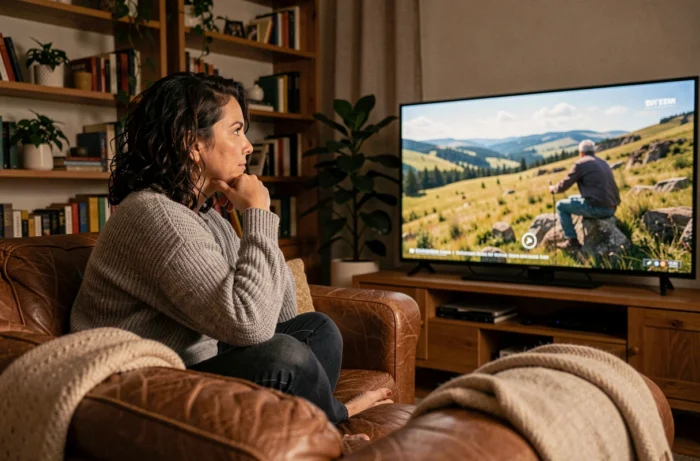
The documentary represents the audiovisual genre that is growing the fastest on free French channels. In 2025, its volume reached 21,475 broadcast hours, an increase of 23% according to the Arcom report. This expansion reshapes the landscape of what a viewer can watch without a subscription and raises a concrete question: where does the value concentrate in this now massive offering?
Broadcast Volume and Funding of Documentaries in France: Who Invests, Who Withdraws
The restructuring of TNT and the arrival of new thematic channels partly explain the increase in volume. The other driver is on the side of digital platforms.
| Actor | Investment Evolution (2025) | Trend |
|---|---|---|
| Television Channels | -8% | Decline |
| Platforms (SVOD, AVOD) | +32% | Strong Increase |
This shift changes the production conditions. Platforms finance documentaries designed from the outset for international distribution, often with budgets exceeding those of a typical time slot on France 5 or Arte.
On the other hand, free channels retain a significant advantage: live audience. A documentary scheduled in prime time on a public channel reaches an audience that would never have sought it out on a platform. This discovery mechanism remains difficult to replicate in an algorithmic environment.
To explore recent French productions in this changing context, the documentaries on Euromedia Television cover a range of films and reports accessible online.

Thematic Channels and Nature or History Documentaries: A Loyal Audience Often Underestimated
Médiamétrie’s analyses for the 2025-2026 season confirm that the thematic channels attract a regular and engaged audience. This is not insignificant: a viewer who turns on a channel dedicated to nature, animals, or history actively chooses the genre.
This audience differs from that of generalist channels in its behavior. The time spent per session is longer, and zapping is less frequent. For advertisers, the context is more qualified. For producers, the recurrence allows for financing documentary series in multiple episodes rather than standalone films.
Nature and Animals: The Pillar of Thematic Schedules
Animal documentaries and films about the planet remain the best performers in terms of loyalty. The format works because it combines spectacular visual storytelling with a duration suitable for a full evening.
- Series on African wildlife or the oceans generate stable audiences week after week, an asset for programmers
- Documentaries on French nature (forests, coastline, rural world) attract an older but very dedicated audience, with high completion rates
- Short formats on domestic animals or urban biodiversity are developing as complements, especially in access prime time
History and Society: The Ground for Major Documentary Series
Historical series like the Apocalypse franchise (broadcast on France 2) have shown for years that a documentary can compete with fiction in prime time. The history documentary attracts an audience that goes beyond the circle of enthusiasts, provided that the production includes colorized archives or well-crafted reconstructions.
Social documentaries, on the other hand, find their strength in local anchoring. A film about a farming family or a French judicial case speaks directly to the viewer’s experience. The proximity of the subject often compensates for a modest production budget.

Sports Documentaries and Digital Broadcasting: The Revealing Case of YouTube
France Télévisions has released a figure that illustrates a rapidly accelerating phenomenon: UTMB, the race of their lives has surpassed 600,000 views on YouTube, becoming the most-watched documentary on the group’s YouTube channels in two years.
This result questions the very notion of “television documentary.” The film was produced for television, but it found its largest audience on a free and open platform. The YouTube viewer profile differs: younger, more connected to sports practice, and less inclined to watch linear television.
In contrast, a 90-minute historical documentary struggles to replicate this pattern on YouTube. The long format without an identifiable star or pre-existing sports community does not benefit from the same viral effect. The average viewing duration on YouTube remains significantly lower than that of a traditional television broadcast.
Criteria for Spotting a Documentary Worth the Time Invested
With over 21,000 hours broadcast per year, sorting becomes a task in itself. A few concrete markers help distinguish a noteworthy film from mere filler.
- The presence of unpublished archives or exclusive access (shooting within an institution, long-term immersion) signals an ambitious production effort
- An identified director with a verifiable filmography offers a minimal guarantee of authorial perspective, as opposed to stock image compilations
- The documentary’s length should correspond to the density of the subject: a well-constructed 52-minute standalone is often better than a series stretched over six episodes
- The channel or platform of first broadcast remains an indicator: Arte, France 5, and the documentary slots of France 2 maintain demanding selection committees
French documentary is undergoing a period of rapid transformation. The volume is exploding, funding sources are being redistributed, and viewing screens are multiplying. In this context, the quality of a film no longer depends solely on its budget, but on the uniqueness of its perspective and the depth of its access to reality.