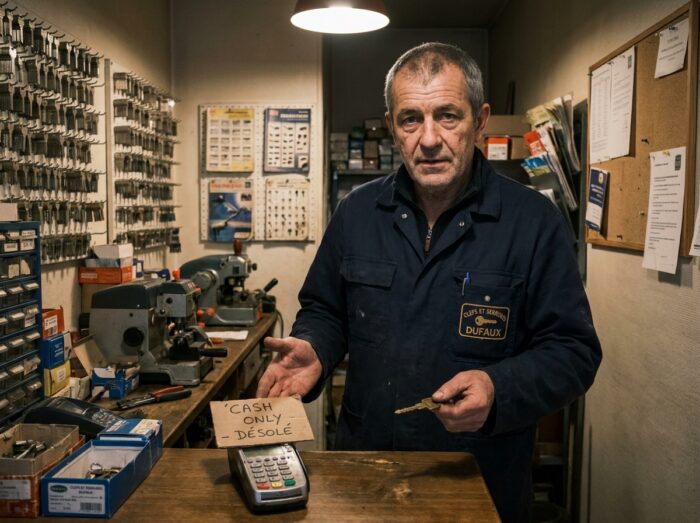
A locksmith who arrives urgently at 10 PM for a slammed door often has a payment terminal in his bag, sometimes not. The refusal of certain payment methods by locksmith professionals is not a whim. It is explained by a tangle of financial, regulatory, and logistical constraints that the client, relieved to regain access to his home, rarely perceives.
Electronic invoicing and locksmithing: a constraint that reshapes habits
The least visible issue in the refusal of certain payments has nothing to do with bank commissions. Since September 1, 2026, businesses subject to VAT must be able to receive electronic invoices. Very small enterprises, small and medium-sized enterprises, and micro-enterprises must issue them by September 1, 2027.
For a locksmith working for a property manager, a real estate agency, or a company, this reform requires linking each payment to compatible software. A check received on the landing of a building at midnight does not easily fit into a dematerialized invoicing chain. A promised bank transfer “tomorrow morning” does not either.
The credit card or the payment link sent via SMS provides a timestamped confirmation of receipt, directly usable for e-reporting. The professional who refuses the check does not show distrust towards his client: he anticipates an administrative obligation whose non-compliance could cost him dearly. To obtain more details on the payment methods commonly accepted during an emergency intervention, the legal framework should be consulted in advance.
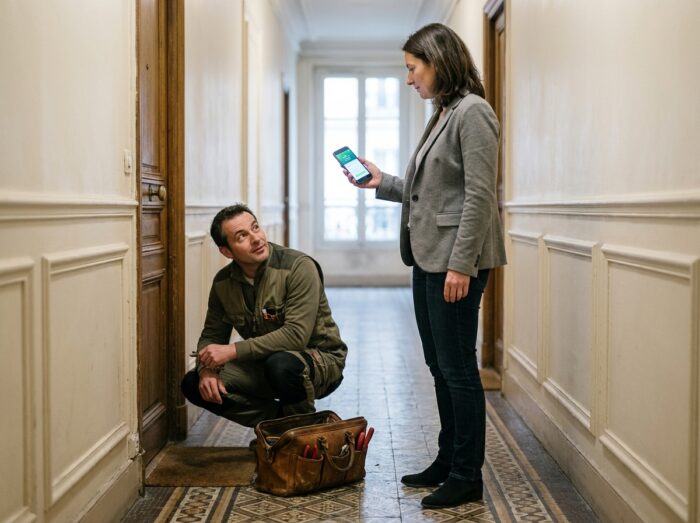
Commission fees and the real margin of an emergency locksmith
The most well-known argument remains that of the commissions charged on card payments. On an intervention billed at a few hundred euros, the commission represents a modest amount in absolute terms. However, the net margin of a locksmith after travel, fuel, insurance, and social charges is often much thinner than what the displayed price suggests.
A craftsman in a micro-enterprise, who benefits from the VAT exemption, does not recover VAT on his material purchases (cylinders, locks, tools). Every percentage deducted from the receipt directly cuts into his income. The calculation quickly becomes unfavorable when the professional multiplies small interventions.
The check, a concrete risk of non-payment
A bounced check remains a reality in home repairs. A locksmith who opens a slammed door for an unknown individual late at night has no way to verify the solvency of the check handed to him. Recovering an unpaid check involves lengthy procedures, often disproportionate to the amount at stake.
The refusal of the check is therefore not arbitrary. It stems from field experience: an unpaid check costs more to recover than the intervention itself.
Legal framework: what a professional has the right to refuse
French law allows a professional to refuse certain payment methods, provided he informs his clients. According to the site entreprendre.service-public.fr, a professional adhering to an approved management center must accept at least one of the two following methods: the check or the credit card. He can therefore refuse one if he accepts the other.
For cash, the rule is different. A professional can refuse it beyond a certain amount or for practical reasons (lack of change, security). The obligation to inform is key: the locksmith must clearly display the accepted payment methods before the intervention.
- The signed estimate before the intervention must mention the accepted payment methods, which protects both parties.
- A professional not adhering to a CGA has broader freedom in choosing the payment methods he accepts.
- Displaying in the intervention vehicle or on the estimate is sufficient to fulfill the prior information obligation.
Micro-entrepreneurs and specific obligations
The status of micro-entrepreneur does not exempt from the new obligations related to electronic invoicing. A locksmith in a micro-enterprise is subject to receiving electronic invoices and, depending on his clientele (professionals, property managers), to e-reporting. This constraint pushes some to favor an immediately traceable payment associated with their invoicing software.
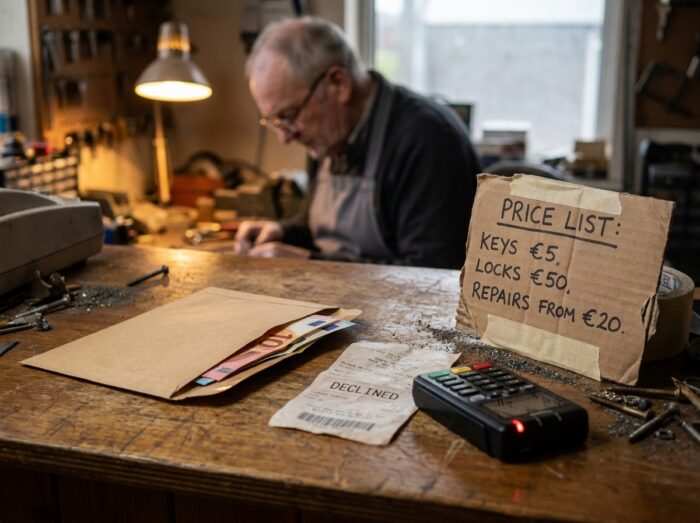
Emergency interventions: why the context of repairs changes everything
Locksmithing repairs combine two particularities that almost do not exist in any other craft profession. First, the service is completed before the price is truly “felt” by the client. Once the door is opened, the perceived value of the service drops sharply. Secondly, the intervention often takes place outside of standard banking hours.
A locksmith called on a Sunday evening cannot verify a check, does not always have a stable connection for his payment terminal, and rarely carries cash to provide change for a bill. The emergency context mechanically reduces viable payment options.
Cash payment, when accepted, poses another problem: traceability. A craftsman who regularly accepts cash without being able to justify each transaction exposes himself to difficulties during a tax audit, especially with the strengthening of data transmission obligations planned by the electronic invoicing reform.
Estimates and pricing transparency: the real lever to avoid disputes
The question of the payment method often masks a deeper issue: the lack of a clear estimate before the intervention. A locksmith who announces his price, specifies the accepted payment methods, and has a signed estimate before touching the lock protects himself against the majority of conflicts.
- The estimate must detail the price of travel, labor, and parts (cylinder, lock) separately.
- The payment conditions (card, cash, transfer) are included in the estimate, which commits the client before the work begins.
- A visible SIRET number on the estimate and invoice allows the client to verify the legal existence of the locksmith business.
The refusal of a payment method, when announced in advance, is neither a scam nor an abuse. It reflects the constraints of a profession where urgency, accounting obligations, and the risk of non-payment intersect at every intervention. The locksmith who refuses your check at 11 PM on a building landing is mostly applying a management logic rather than a commercial strategy.