The BSR, now referred to as the category AM of the driving license, does not have any national free training scheme. Any promise of completely free training deserves a thorough analysis of the financial setup behind it. Options exist, but they fall under local, associative, or institutional mechanisms that we detail here.
Funding for the BSR: setups that allow training without direct costs
The practical training for the AM license varies in cost depending on driving schools and geographical areas. This fee covers the driving hours supervised by a certified instructor and the provision of the vehicle (moped or light quadricycle).
Several mechanisms allow this cost to be neutralized for the candidate, without the training becoming strictly free. The funder changes, not the service.
- Municipal or departmental aids are the most common lever: some local authorities subsidize all or part of the BSR for young people residing in their territory, often subject to income conditions or civic engagement (voluntary service, associative volunteering).
- Local missions, as part of employment support, sometimes include funding for the AM license in a professional integration pathway, especially when mobility is a condition for accessing an internship or contract.
- Road safety or popular education associations occasionally organize funded training sessions in partnership with certified driving schools. These schemes generally target audiences far from mobility.
We recommend contacting the town hall, the CCAS, or the local mission directly before enrolling in a driving school. The information desk varies from one municipality to another, and no centralized directory lists these aids. To understand where to take the BSR for free, you must first identify the applicable local funder for your situation.
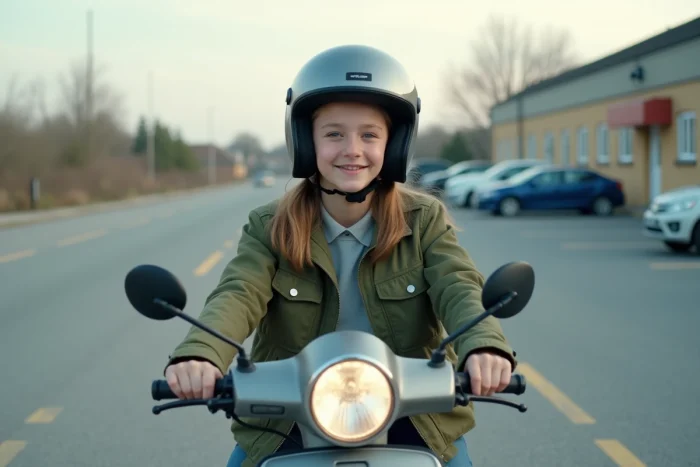
Administrative prerequisites for the AM license often poorly anticipated
The theoretical part of the BSR is not managed by the driving school. It relies on the validation of the ASSR 1, ASSR 2, or ASR, obtained in school (middle school) or through a GRETA for candidates not enrolled in school. Without this document, no registration for practical training is accepted.
The ASSR is prepared in the fifth grade (ASSR 1) or in the third grade (ASSR 2). A candidate who has lost their certificate must request a duplicate from the original school. If the school has closed or cannot find the document, the process becomes more complex: they must then take the ASR at a GRETA or an accredited center.
The case of individuals born before 1988
No driving license is required to operate a moped or light quadricycle if the driver was born before 1988. This regulatory exemption eliminates any question of cost or training. However, vehicle insurance remains mandatory, and the insurer may request proof of date of birth.
Practical BSR training: regulatory content and pitfalls to avoid
The practical training lasts a minimum of eight hours, spread over at least two days. It is divided into off-road sequences, on-road sequences, and risk awareness. The candidate chooses an option at the time of registration: moped (two or three wheels) or light quadricycle (small car).
This choice of option determines the type of vehicle authorized after obtaining the AM license. Changing options requires retaking the complete training, which many candidates are unaware of. We regularly observe young people enrolled in the moped option who later realize they would have preferred the quadricycle option.
Criteria for selecting a driving school for the BSR
Not all driving schools offer AM training. A specific prefectural approval is required, and some driving schools limit themselves to licenses B and A. Check the approval before paying a deposit.
- Request the detailed program for the eight hours: a serious school provides a precise schedule with off-road and on-road slots.
- Ensure that the vehicle used for training corresponds to the chosen option (moped or quadricycle).
- Ask the driving school about the certification issuance rate: unlike the B license, there is no final exam, but the instructor may refuse to validate the training if the skills are not acquired.
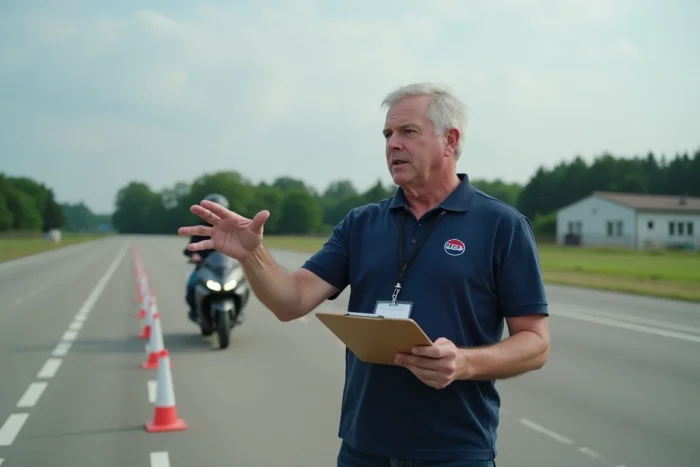
AM license and insurance: the constraint that no one budgets for
Obtaining the BSR is not enough to ride. The vehicle’s civil liability insurance is a legal obligation, and rates for a minor driver on a moped remain significant. For a 14-year-old with no prior history, the annual premium can exceed the cost of the training itself.
Families looking to reduce the overall BSR budget often overlook this item. Comparing insurance offers even before starting training allows for anticipating the actual cost of putting the vehicle on the road.
The AM license issued since 2013 is registered electronically in the driving license file, without points being assigned. Old orange BSR cards (prior to 2013) must be converted to an AM license via the ANTS to appear in the national file. In case of loss of the orange card, the administration does not keep a record: only the original driving school or the insurer may hold a copy.
Thus, the free BSR remains a matter of local setup, not an acquired right. Before looking for a driving school, identify your potential funder, gather your ASSR, and include the cost of insurance in your total budget.