In France, around 31,000 people are centenarians in 2024. Among those who reach the age of 95, there are much more diverse profiles than one might imagine. Understanding who these very old French people are requires looking beyond national averages of life expectancy, by cross-referencing demographic data, social inequalities, and residential trajectories.
Birth cohorts around 1930: the filter of war and post-war work
The French who reach 95 years old today were born around 1930-1931. We are talking about generations that experienced malnutrition during World War II, followed by the hardships of reconstruction work.
This journey acted as a double filter. First, biological: the most fragile organisms did not survive childhood nutritional deficiencies. Then, professional: the physical jobs of the post-war period prematurely wore out part of this cohort, excluding from very old age those whose bodies had accumulated too many stresses.
To better understand the percentage of the population living up to 95 years, it is essential to keep this historical context in mind. The survivors of these generations are not a representative sample of their age group: they are the survivors of a brutal selection.

Social inequalities in mortality after 90: the gradient that diminishes
Research from Ined and Insee on differential mortality shows that working-class men have a much higher risk of death than executives throughout life. A former worker statistically has much less chance of reaching 80 years than a former senior executive.
But an interesting phenomenon appears after 90 years. The mortality gap between social categories narrows. Researchers explain this by a selection effect: workers who reach 95 years are the most robust in their category. Their bodies have withstood decades of physical work and, often, less favorable medical living conditions.
The social gradient diminishes among the very old, without completely disappearing. Access to care, nutrition, and isolation continue to create differences, but individual biology takes precedence over social determinants at these extreme ages.
The weight of gender in statistics
Women represent about 86% of centenarians in France. This female overrepresentation is evident from the age of 95, with a marked imbalance. The men who reach this age constitute a numerically small group, which further reinforces the selection effect described above.
Among women, the increase in life expectancy after the pandemic has been faster than among men, with a significant catch-up after the decline of 2020-2021. Female cohorts born around 1930 also benefit from a long-documented hormonal advantage, although reports vary on the exact extent of this effect at very old ages.
Residential trajectories of those aged 95 and older: home, nursing home, or intermediate housing
The image of the nonagenarian in a nursing home no longer corresponds to the majority reality. According to Drees, a growing share of those aged 95 and older remains at home thanks to professional assistance (SAAD, SSIAD). The arrival in institutions around 85-90 years, once common, is declining in favor of intermediate solutions.
- Home help and support services (SAAD) allow individuals to stay at home with daily visits for meals, personal care, and mobility
- Home nursing services (SSIAD) provide regular medical follow-up without permanent hospitalization
- Senior service residences and intermediate housing offer a secure environment while preserving autonomy, with private spaces and shared services
This shift profoundly changes the profile of those who reach 95 years. Staying at home requires sufficient wealth to finance assistance, or a mobilizable family support system. Wealth inequality plays a direct role here: intergenerational transfers, retirement rights, and resource levels partly determine living arrangements, and by extension, the quality of aging.
Life expectancy in France after the pandemic: rebound and new trends
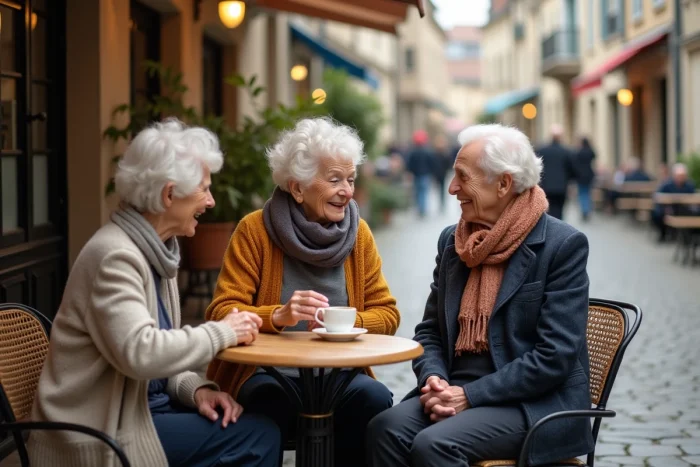
Life expectancy declined in 2020-2021 due to the pandemic, severely impacting the elderly. Since then, the trend has reversed with a rebound, but the increase has not returned to the nearly continuous pace observed since the early 2000s.
For those aged 95-99 specifically, the probability of reaching 95 years first dropped and then rose. This statistical yo-yo masks very different realities depending on the regions. In fact, Ined noted an unexpected frequency of supercentenarians in Guadeloupe and Martinique, a phenomenon that raises questions about protective factors related to diet, climate, or local lifestyles.
The question of the mortality ceiling at very old ages
Demographers wonder if the risks of death plateau beyond 105 years. Data from the international longevity database suggest a slowdown in the increase of the risk of dying at extreme ages, although a definitive conclusion has yet to be reached.
France has about 31,000 centenarians, which is thirty times more than fifty years ago. Supercentenarians, aged 110 and older, are almost all women. What is striking about these figures is less their magnitude than the speed at which the very old population is renewing and diversifying, driven by reforms in the healthcare system, wealth transfers, and a generational effect that the next cohorts may not necessarily replicate in the same way.